If you own a home on the Texas Gulf Coast, the weakest part of your house in a hurricane is probably the one you park behind every day. The garage door is the biggest opening in most homes, and building-science research treats it as a leading failure point in high wind. We're a Sugar Land garage door company that runs storm-damage calls across Greater Houston, so we see how these doors fail and which ones hold. Questions while you read? Call (713) 324-8950.
24/7 emergency service · 5.0★ · 470+ reviews · Licensed & Insured · Authorized Dealer for Clopay · Amarr · C.H.I.
Why the garage door is your home's biggest hurricane weak point
Most homeowners worry about windows and shingles before a storm. The garage door rarely makes the list, and it belongs near the top.
The Insurance Institute for Business & Home Safety (IBHS) calls the garage door "typically the largest opening in the exterior walls of a home." FEMA's Wind Retrofit Guide says garage doors are "large, unreinforced openings that are commonly damaged during high-wind events." A two-car door can run 16 feet wide with no post in the middle, which gives the wind a big, flexible panel to push on.
How a garage door failure spreads
The damage happens in three steps, and each one makes the next worse.
- Breach. A door that isn't wind-rated buckles under the pressure, usually at the center of a wide two-car door. The Building America Solution Center puts it bluntly: "A garage-door failure is a huge breach of the building envelope."
- Pressure builds inside. With the door gone, wind pours into the garage faster than it can get out. The same source says the breach "can increase internal pressures to the point that they push out windows, walls, doors, and roofs, causing building failure."
- The house fails. That pressure can push out walls and lift the roof off the wall plates. A door problem becomes a whole-house problem.
The Federal Alliance for Safe Homes (FLASH) says "more than 90% of house damage in severe wind events begins when garage doors separate from their mounting, collapse, or cave in due to wind pressure and/or windborne debris impacts." FLASH bases that on decades of post-storm damage investigations.
What a wind rating means
A wind-rated garage door carries a design-pressure rating, and the rating it needs depends on the wind speed and exposure at your site. The Building America Solution Center lists minimums of roughly +26 / -28 pounds per square foot for a two-car door in an exposed spot, and about +19 / -21 psf for one in a neighborhood sheltered by other buildings and trees.
Wide two-car doors are the most vulnerable. Their span flexes the most and can pull out of the tracks when the pressure inside and outside the garage push against each other. If you have a single 16-foot door with no vertical reinforcement, start there.
How wind-rated doors work
A wind-rated (or hurricane-rated) door is built and tested to a design-pressure rating. It has reinforcement in the panels, heavier tracks, and stronger hinges and brackets. Impact-rated doors also resist windborne debris. Garage doors are pressure-tested under ANSI/DASMA 108 or ASTM E330, and impact-rated garage doors are tested for debris and cyclic pressure under ANSI/DASMA 115, a garage-door standard built on ASTM E1886 and E1996.
We're an authorized dealer for Clopay, Amarr, and C.H.I., and we pick between them based on your door size, exposure, and code zone. Each brand labels its wind-load doors differently.
- Clopay WindCode®. Clopay rates wind-load doors from W1 to W9, and a higher number means a stronger door. Clopay calls its WindCode doors Storm Ready™ because the reinforcement is built in, so you lock the door before a storm instead of installing posts.
- Amarr WindPro™. Amarr rates its wind-load reinforcement by "WP" level, and almost every Amarr door line offers it, so you don't give up style to get strength.
- C.H.I. Overhead Doors. Many insulated steel models come in wind-load-rated versions, both impact and non-impact, with heavier-gauge track and added struts sized to the required design wind pressure.
The right rating depends on where your home sits and what your local code requires, which the Texas section below covers. In the coastal zone, a wind-rated door may be required and inspected. For installed prices, see our Houston garage door replacement cost guide or call (713) 324-8950. Every quote we give is for your specific door and opening.
Live on the coast and weighing a new door? Our installation team specs wind-rated doors across the Houston metro.
Brace it or replace it?
An existing door gives you two choices. You can reinforce it with a brace, or replace it with a wind-rated door. Which one makes sense depends on the door.
Bracing. A brace kit adds vertical posts from floor to ceiling, sometimes with horizontal struts, anchored into the concrete slab and the ceiling joists, never drywall. A retrofit can also add heavier-gauge tracks, track brackets fastened to wall studs, heavy-duty rollers, and hurricane-rated hinges. At retail, a post-style brace for a single door runs about $270–$365 for the hardware, and a two-car door needs two or three braces, about $540–$890. Those are general market prices, not ours, and installation is extra.
A brace only works if it's anchored into the structure. One lag-bolted into drywall will pull straight out under load, so have a professional anchor it.
Replacing. A wind-rated door is the permanent fix, and in coastal zones it may be required for windstorm insurance or by local code. Many newer wind-rated doors have the reinforcement built in, so there's nothing to set up before each storm. Some still rely on removable posts or a lock you set ahead of a storm, so check the manufacturer's instructions for your model. A new door costs more up front than a brace, and it ends the yearly scramble every June. For our installed prices, see the replacement cost guide, and we'll quote your specific door.
Our rule of thumb. A newer, sound door at an inland home can be braced as a stopgap. An older two-car door that flexes, or any door in the coastal code zone, is usually worth replacing with a wind-rated one. Not sure which you have? A maintenance inspection will tell you.
What Texas coastal code requires, and where
Most national storm-prep guides skip the Texas rules, and those rules decide whether a wind-rated door is optional or required for your home.
In the coastal windstorm zone, construction is certified to the International Residential Code (for houses) or the International Building Code, as adopted by the Texas Department of Insurance (TDI). Since April 1, 2026, that means the 2024 editions, which set wind loads using ASCE 7. Garage doors have to meet the design pressure for the site.
The rule that matters most for insurance is TDI's windstorm program. TDI designates a catastrophe area that covers the 14 first-tier coastal counties, plus the parts of Harris County that are both east of State Highway 146 and inside the city limits of La Porte, Morgan's Point, Pasadena, Seabrook, or Shoreacres. In that area, new construction and alterations, garage doors included, must be built and inspected to TDI's specifications for the home to be insurable through the Texas Windstorm Insurance Association (TWIA). TDI issues a WPI-8 Certificate of Compliance when the work is inspected as it's done, or a WPI-8-E when an engineer certifies finished work.
| Where your home is | In the TDI catastrophe area? | What it means for your garage door |
|---|---|---|
| Galveston County (Galveston, League City, Texas City) | Yes, a first-tier county | New and replacement doors must meet wind-load design pressures, and TWIA coverage needs a WPI-8 certificate, plus whatever local code and permits require |
| Chambers County (the Chambers County side of Baytown, Mont Belvieu) | Yes, a first-tier county | The same rules as Galveston County |
| Harris County east of SH-146, inside La Porte, Morgan's Point, Pasadena, Seabrook, or Shoreacres | Yes, but only that strip. Most of Pasadena and the Harris County side of Baytown are outside it | The same rules as Galveston County |
| Inland Harris County (most of Houston) | No | No WPI-8 requirement, but hurricane gusts still reach inland, so we strongly recommend a wind-rated door |
| Fort Bend County (Sugar Land, Katy, Richmond, Missouri City) | No | Not required by code, but hurricane-force wind and debris still hit these homes |
If you live in Galveston or Chambers County, or in that Harris County strip, a wind-rated door may be required and inspected. Elsewhere in the metro it's your call, but inland homes still take hurricane-force gusts. Hurricane Ike (2008) gusted to about 92 mph at Hobby Airport, and Hurricane Beryl (July 2024) knocked out power to about 2.26 million CenterPoint customers in the Houston area, and about 2.7 million across southeast Texas. Harvey was different. It was a catastrophic flood for Houston, and its hurricane-force winds stayed near its Rockport landfall. Inland wind and inland flooding are separate threats.
Code and zone lines change, so check with your local building official or a windstorm inspector before you buy.
When to act before a storm
The most common mistake we see is waiting until the forecast cone points at Houston. By then every contractor in the metro is booked.
Before the season (now through May). It's the only stretch with no time pressure. Get a pre-season inspection and find out whether your door is wind-rated (look for a design-pressure label or ask the inspector). Decide between bracing and replacing while you have time to compare quotes.
One week out, when a storm is in the forecast cone. This is your last calm window to book bracing or a repair. Contractors fill up fast as a storm approaches, and parts run short. If you've been putting off a wobbly door or a worn spring, book it this week.
48 hours out. It's too late for structural work. Anchored posts, track upgrades, and a professional brace install all belong earlier, before the season or at the latest the week before. At this point the only safe reinforcement is a removable, manufacturer-approved brace you already own, set up while the weather is still calm. Then clear the garage of anything the wind could throw. Once the wind picks up, nobody should be on a ladder fitting braces.
When the wind arrives. Keep the door closed and locked. Don't open it to "equalize pressure." That's a myth, and an open door lets in the internal pressure that tears houses apart (see how a failure spreads, above). Stay away from the door, and only park vehicles against it if local emergency officials tell you to.
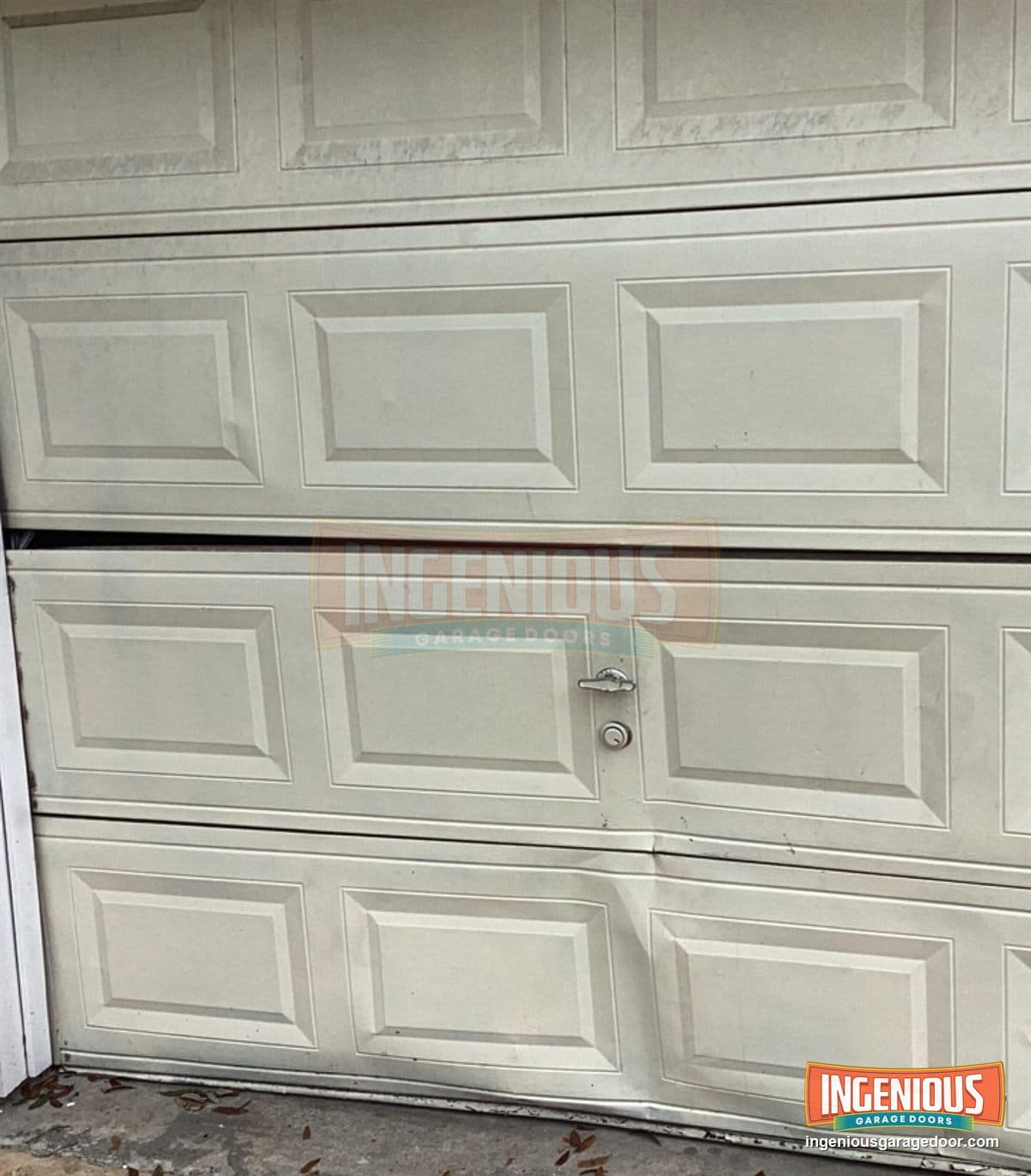
After the storm. Look before you touch the opener. Check for bowed panels, a door off its track, bent tracks, frayed or snapped cables, and broken springs. Don't run a door that's visibly damaged. A bent track or broken spring can bring a heavy door down hard. Call for a professional assessment. Our off-track repair, garage door repair, and 24/7 emergency repair crews work across the metro.
Your hurricane garage door checklist
Print or save this, and run through it before the season and again when a storm enters the Gulf.
Before the season
- Find out whether your door is wind-rated (design-pressure label or a professional inspection)
- Note any wide two-car or older doors, the most vulnerable kind
- Check springs, cables, rollers, and tracks for wear, rust, or damage
- Make sure your opener's battery backup works
Before the season, or one week out
- Decide whether to brace or replace, and book it while contractors are free
- If you brace, confirm the posts are anchored to the slab and joists, never drywall
- Replace worn springs, cables, and rollers before the season starts
48 hours out
- Confirm any permanent reinforcement is already in place (it's too late to start structural work)
- Set up a removable brace you already own while the weather is calm, following the manufacturer's instructions
- Clear loose items out of the garage (bikes, tools, trash cans, patio furniture)
- Photograph the door and its hardware for insurance
- Fuel or charge your cars and move essentials out, in case the door won't open later
During the storm
- Keep the door closed and locked
- Don't open it to "equalize pressure"
- Stay away from the door
After the storm
- Check for bowing, a door off its track, bent tracks, and cable or spring damage before using it
- Don't run a door that's visibly damaged
- Photograph the damage for your claim
- Call for a professional assessment at (713) 324-8950
After the storm, we run emergency calls across Houston
When a storm knocks a door off its track at 2 a.m., or a snapped spring traps your car the next morning, you shouldn't have to wait for business hours. We dispatch from our Sugar Land office across Greater Houston, including coastal-corridor cities like Houston and Baytown and Galveston County towns like League City, Dickinson, and La Marque. We offer 24/7 emergency service. A real person answers from 7am to 8pm, and after-hours calls reach our on-call technician.
The homeowners we see come through a hurricane in the best shape dealt with their garage door in the calm week before the storm. Once a storm is in the cone, every contractor in Houston is booked, and nobody can safely brace a door in rising wind. The door is the biggest opening in your house, so deal with it early.
Hurricane garage door FAQ
Is my garage door strong enough for a hurricane?
Look for a design-pressure (DP) or wind-load label on the door. A wind-rated door is built and tested to a specific pressure. If there's no label, don't assume it's rated. An older or wide two-car door with no visible reinforcement usually isn't. Our maintenance service includes an honest assessment.
Should I brace my door or replace it with a wind-rated one?
It depends on the door. A newer, sound door at an inland home can often be professionally braced as a stopgap. An older two-car door that flexes, or any door in the coastal code zone, is usually better replaced with a wind-rated door. Either way, a brace has to be anchored into the structure. Call (713) 324-8950 or see our installation service.
Do I legally need a wind-rated garage door in the Houston area?
It depends on where you live. In the TDI catastrophe area (the 14 first-tier coastal counties, including Galveston and Chambers, plus the parts of Harris County that are east of SH-146 and inside La Porte, Morgan's Point, Pasadena, Seabrook, or Shoreacres), new and replacement garage doors must meet wind-load design pressures. Insuring the home through the state windstorm program (TWIA) then takes a WPI-8 or WPI-8-E certificate, on top of local code and permits. Inland Fort Bend and most of Houston are outside the catastrophe area, so no WPI-8 is required there, though local permits still apply and we strongly recommend a wind-rated door. Confirm the details with your local building official or a windstorm inspector.
How much does a hurricane brace or wind-rated door cost?
At retail, a post-style brace for a single door runs about $270–$365 for the hardware, and a two-car door needs two or three braces, about $540–$890. Installation is extra, and these are general market prices, not our quote. For an installed wind-rated door, see our Houston replacement cost guide or call for a price on your door.
Should I open my garage door during a hurricane to equalize pressure?
No. It's a myth, and a dangerous one. Keep the door closed and locked. An open door lets wind pressurize the house, which is the exact failure you're trying to prevent.
What should I do if my garage door was damaged in a storm?
Don't use it. A bent track, broken spring, or off-track door can drop a heavy panel. Keep people and cars clear and call for an assessment. Our 24/7 emergency repair and off-track service cover the whole metro.
When is the best time to prepare?
Before the season, or at the latest the calm week before a storm enters the cone, while contractors still have openings. That's when brace installs, track upgrades, and new wind-rated doors should happen. Two days before landfall it's too late to start, and the only safe step left is setting up a removable brace you already own while the weather is calm. Once the wind arrives, leave the door alone.
Get your door ready before the next storm
Gulf hurricane season runs June through November, and the best time to deal with your garage door is the quiet stretch before a storm has a name. We're a licensed and insured, 5.0★ team working across Greater Houston, and we handle inspections, professional bracing, wind-rated doors, and storm repairs.
Schedule an inspection · Request an estimate · (713) 324-8950
Serving Houston, Baytown, Sugar Land, and the greater metro · 24/7 emergency service · Authorized Dealer for Clopay · Amarr · C.H.I.
Sources & references
This guide draws on the following primary sources:
- Building America Solution Center (U.S. DOE / PNNL), "Garage Doors Are Pressure Rated": the failure chain (breach → internal pressurization → building failure); double-car design pressures of roughly +26 / -28 psf (exposed) and +19 / -21 psf (sheltered); garage-door pressure testing under ASTM E330 / ANSI/DASMA 108.
- Insurance Institute for Business & Home Safety (IBHS), "Garage Doors in High-Wind Designations": the garage door as "typically the largest opening in the exterior walls of a home."
- FEMA P-804, Wind Retrofit Guide for Residential Buildings: garage doors as "large, unreinforced openings that are commonly damaged during high-wind events."
- Federal Alliance for Safe Homes (FLASH), "Strengthen Your Garage Door": "more than 90% of house damage in severe wind events begins when garage doors separate from their mounting, collapse, or cave in due to wind pressure and/or windborne debris impacts" (quoted verbatim; FLASH attributes it to decades of post-storm damage investigations).
- Texas Department of Insurance (TDI) windstorm program: the designated catastrophe area (14 first-tier coastal counties plus the parts of Harris County east of SH-146 inside La Porte, Morgan's Point, Pasadena, Seabrook, and Shoreacres); the WPI-8 and WPI-8-E certificates required for TWIA windstorm insurability, which TWIA says covers garage doors. Starting April 1, 2026, TDI windstorm certification references the 2024 International Residential Code or 2024 International Building Code, depending on the structure.
- DASMA (Door & Access Systems Manufacturers Association) standards: ANSI/DASMA 115 (windborne-debris impact and cyclic pressure, built on ASTM E1886 and E1996); ANSI/DASMA 108 and ASTM E330 (pressure testing); ASCE 7 wind loads referenced by the adopted code. On keeping the door closed: DASMA, "How Not to Prepare a Door for a Hurricane".
- Storm history: National Hurricane Center reports on Hurricane Ike (2008), Hurricane Harvey (2017), and Hurricane Beryl (2024); the CenterPoint outage figure as reported by ABC13.
- Manufacturer wind-load systems: Clopay WindCode® (W1–W9) and Storm Ready™; Amarr WindPro™ WP ratings; C.H.I. Overhead Doors wind-load-rated steel models.
- Brace prices ($270–$365 per single-door post brace; two or three braces for a two-car door): retail listings checked in October 2026, including Secure Door residential braces. This is a general market range, not an Ingenious price.