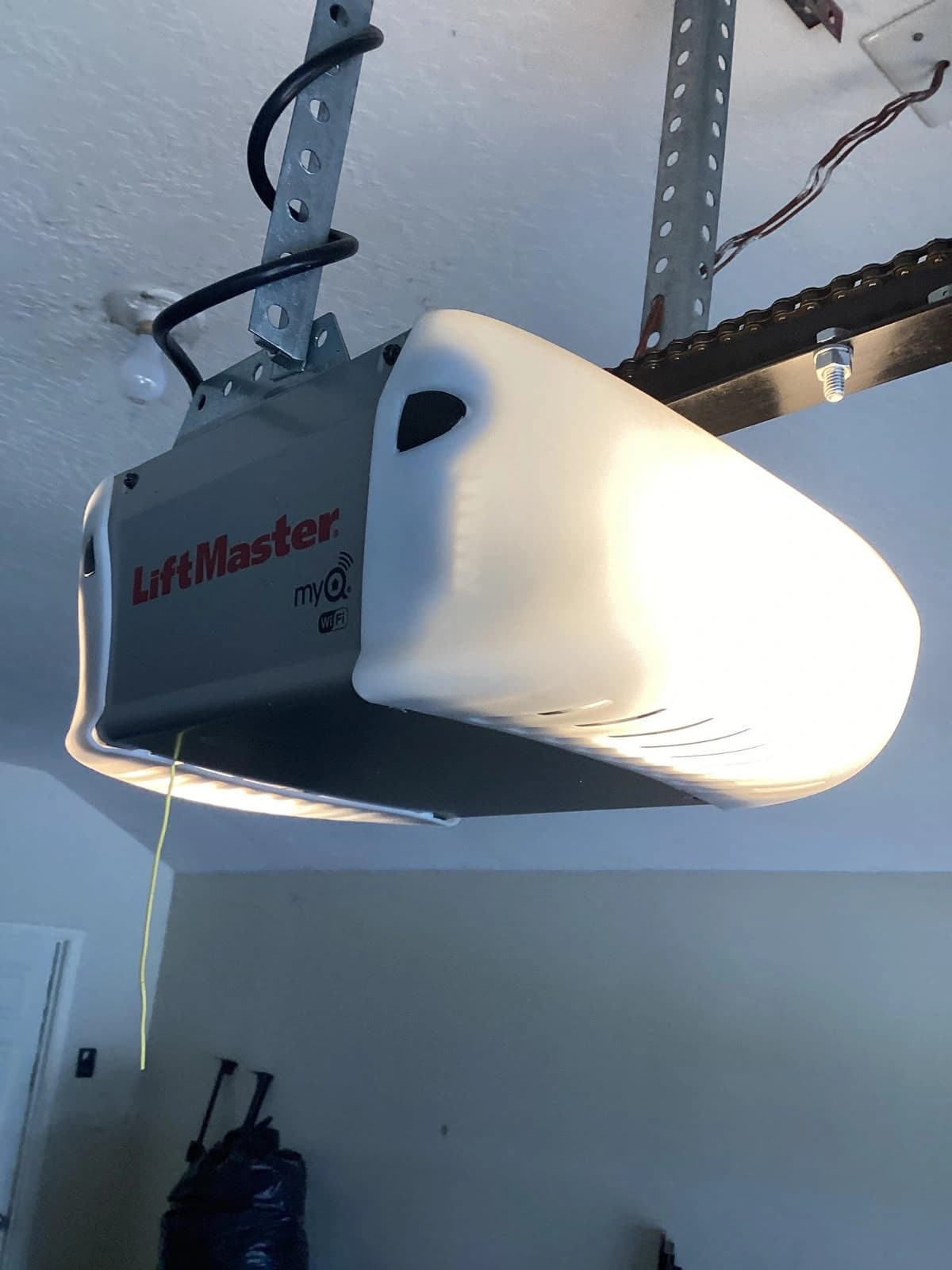
When a LiftMaster opener quits, the cause is usually small: a tripped breaker or GFCI, a dead remote battery, or safety sensors that can't see each other. Check power first, then the remote, then the little lights on the sensors. If the motor runs and the door doesn't budge, the trolley has probably been released. You can handle all of those yourself. Springs, cables and a motor that won't run with good power are where you stop and call someone.
One warning before you start: if you heard a loud bang from the garage, or the door feels far heavier than normal, you likely have a broken spring. Don't keep running the opener against it. That strips gears and can bend the door.
Remote or wall button not working
Swap the remote battery first. Most LiftMaster remotes take a 3V coin cell, usually a CR2032. If the remote only works up close, a weak battery is the usual reason.
If a fresh battery doesn't help and the wall button still works, pair the remote again:
- Press and release the Learn button on the motor unit. Don't hold it; holding it for about 6 seconds erases every remote and keypad.
- Within 30 seconds, press and hold the remote button until the opener lights blink or you hear clicks.
- Test it from the driveway.
The Learn button color tells you which remotes will work. Our Chamberlain remote programming guide has the chart, and it applies to LiftMaster since both come from the same company.
If the wall button is dead too, check the thin wire running from the button to the motor unit for a pinched staple, a loose terminal screw or corrosion.
Door reverses right away or won't close
This is the most common LiftMaster complaint. The door starts down, then stops and goes back up, or the lights flash and it won't close at all.
Read the sensor lights
There's a photo-eye on each side of the door, about 6 inches off the floor. One sends a beam and the other receives it.
| What you see | What it means |
|---|---|
| Amber on one sensor, solid green on the other | Beam is connected, sensors are fine |
| Green off or flickering | Sensors out of line or something's in the way |
| Amber off | No power to the sensors, usually a loose or broken wire |
Wipe both lenses with a dry cloth. Cobwebs and dust are enough to break the beam. Move trash cans, bikes or anything else near the bottom of the tracks. If the green light is still out, loosen the wing nut on the receiving sensor, tilt it until the green light comes on steady, and tighten it. Full steps are in how to align garage door sensors.
Houston sun can blind the receiving eye. If the door only refuses to close in late afternoon, swap the two sensors so the receiver faces away from the sun.
Check the door before touching the force setting
If the sensors are fine and the door still reverses partway down, disconnect the opener with the door fully closed and move the door by hand. It should glide without catching. A binding door will make any opener reverse, and that's a track, roller or balance problem.
Older LiftMaster models have UP and DOWN force screws on the motor unit. If the door moves freely, turn the DOWN force about a quarter turn and test. Newer models set force automatically when you program the travel limits, so you reprogram instead.
Never crank the force up to make a stubborn door close. After any adjustment, lay a 2x4 flat under the door and close it. The door should touch the board and go back up.
Opener runs but door doesn't move
You hear the motor, maybe see the chain moving, but the door stays put. Usually the trolley has come loose from the carriage. The red emergency release cord unhooks the door so you can lift it by hand in an outage, and it gets pulled by accident more often than you'd think.
To reconnect it:
- Make sure the door is all the way closed.
- If the release lever on the trolley is locked in the released position, pull the cord once more to reset it.
- Press the wall button. The trolley should latch back on with a click as the carriage passes.
Only pull the red cord when the door is fully closed. If the door is open, or a spring or cable is broken, it can drop the moment it's released.
If the motor hums or grinds and nothing moves along the rail, the main drive gear inside the motor head is probably stripped. That's common on older chain-drive units. The gear kit is cheap, but the motor head has to come apart, so most people have it done.
No power or blinking lights
Nothing lights up
- Check the breaker panel.
- Look for a tripped GFCI outlet in the garage and press reset.
- Push the opener's cord all the way into the ceiling outlet.
- Plug a lamp into that outlet to confirm it has power.
If the outlet is live and the opener still shows no life, the logic board or transformer may have failed. Summer storms and surges take out a lot of opener boards around Houston.
Blinking light codes
Many LiftMaster openers flash a diagnostic LED near the Learn button when something's wrong. Count the flashes; the pattern repeats after a pause.
| Flashes | Usual meaning |
|---|---|
| 1 | Sensor wires open or disconnected |
| 2 | Sensor wires shorted or reversed |
| 3 | Wall control wire shorted |
| 4 | Sensors misaligned or blocked |
| 5 | Motor or travel issue; on some models, motor overheated (let it cool 15 to 30 minutes) |
Codes vary by model, and newer Security+ 2.0 units use two-part arrow codes, so check the label inside the light cover if yours doesn't match. Codes 1 through 4 are sensor or wiring problems you can usually trace yourself.
Basic maintenance
Twice a year, lubricate the hinges, roller bearings and opener chain with white lithium grease or garage door silicone spray. Don't lubricate a belt drive. Wipe the tracks clean instead of greasing them, and skip WD-40, which attracts dirt. Our lubrication guide shows where to spray.
Look for loose bolts, frayed cables and worn rollers while you're up there. Once a month, wave a broom handle through the sensor beam while the door closes. It should reverse right away.
When to call a professional
Stop and call if you find:
- A broken spring. Never try to fix springs yourself.
- Frayed or broken lift cables
- A motor that won't run even though the outlet has power
- A failed logic board, or codes that return after you've fixed the wiring
- A stripped drive gear you'd rather not tackle
- A door that drops fast when opening or closing
A dead motor, bad board or stripped gear is opener repair or replacement work. Springs carry enough tension to cause serious injury, so leave spring replacement to a technician. For numbers, see our spring replacement cost guide and opener installation cost guide. If the opener is 10+ years old with a dead motor or board, replacement usually makes more sense.
Houston climate considerations
Summer heat makes the motor work harder, and metal tracks expand enough to cause binding. Humidity speeds up rust on rollers and wire terminals, and corroded sensor connections are a common cause of a door that works one day and not the next. Storm surges can fry the board, so a surge protector on the opener outlet is worth the few dollars.
Still stuck?
If you've checked power, batteries, sensors and the trolley and the door still won't behave, we can help. We're an authorized LiftMaster dealer, so on one visit we'll test the board, gear, sensors and door balance and price the repair before replacing anything. Minor opener repairs start around $85. Call (713) 324-8950 or book online.
Frequently Asked Questions
How long do LiftMaster garage door openers last?
With regular care, 10 to 15 years is common, and plenty run longer. Heat and a poorly balanced door shorten that. Once a 10-plus-year-old unit needs a motor or board, replacement is usually the better spend.
Why does my LiftMaster remote only work when I'm close to the door?
Start with a new battery. If range is still short, make sure the antenna wire on the motor unit hangs straight down, and try removing LED bulbs from the opener, since some cause radio interference.
Why does my opener work intermittently?
Usually a loose or corroded wire at the sensors or wall button, a sensor that's barely in alignment, or a failing logic board. Tighten the wire connections first, then watch the sensor lights while someone runs the door.